Haitians are discovering the full impact of Hurricane Matthew 48 hours after it hit the western part of Haiti. There is plenty of media coverage of the hurricane; this BBC report is one of the best I have seen (click here to read).
The preparation for the hurricane, the immediate impact, and the recovery have reminded me of why Haiti is considered one of the world's most fragile countries (click here to read more about the 2015 Fragile States Index).
Preparation: Efforts were made to communicate to people about the coming hurricane. Beyond warnings made on the radio, messengers were also dispatched on motorcycles to communicate the approaching danger. Social media was also extensively used. The lack of a coherent emergency notification system led to the most vulnerable populations - those who live in poverty and/or in remote areas - being the least likely to be informed of the impending disaster.
Impact: The deforestation that has occurred in Haiti for decades led to an increased likelihood of mud slides and flooding. Bridges, roads, and other infrastructure were washed out, essentially cutting off the western part of Haiti. People who lived in river beds and valleys, who are often some of the poorest of the Haitian population, were particularly vulnerable to the mud slides and flooding. During the time that the hurricane hit western Haiti, there was often no or limited communication.
Recovery: As I followed news reports and social media, it was clear that there was very limited police or government presence in the immediate aftermath of the storm. People were left to fend for themselves. The US navy sent a ship. Local and international NGOs sprung into action. But where was the Haitian government in all of this? Its major announcement seemed to be the delaying of the elections that were scheduled for this Sunday. Meanwhile, thousands are homeless and the risk of disease (such as cholera) is escalating by the day.
Hurricanes impact both the rich and the poor. But, clearly it is the poor who are at most risk and who suffer the greatest. In fragile states such as Haiti, the "evidence of fragility" can be seen in easily destroyed infrastructure and weak government systems. However, the real evidence of fragility is the magnified effects of a disaster on the poor and marginalized.
About Me

- Steve Sider
- I have been an elementary and secondary school teacher and administrator. Currently, I am a faculty member in the Faculty of Education at Wilfrid Laurier University, Waterloo, Ontario, Canada. My M.Ed. and Ph.D. had a focus on the educational and linguistic experiences of children who moved from other countries to Canada.
Thursday, October 6, 2016


Wednesday, September 14, 2016
Innovation and Education: A New Way Forward for Teacher Professional Learning in Fragile Contexts
Education provides the tools for young people to achieve
diversified career options, higher income levels, sustained health, and active
citizenship. How do children access a quality education that leads to these
outcomes? Through skilled and competent teachers and school leaders who
have the capacity to foster these abilities.
I have been engaged, in
partnership with colleagues in Haiti and North America, with fostering teacher
professional learning in Haiti for more than 10 years. We are now scaling this work through week-long,
face-to-face professional development and on-going, on-line support and learning.
We are particularly committed to supporting the capacity of female educators
and students who are often under-represented in the subject areas we have
focused on (mathematics, science, critical literacy, special education, early
learning, and school leadership).
Our vision is founded on a Haitian Creole expression: Piti piti, ti pay pay, zwazo fe nich : little by little, straw by straw, the bird builds its nest. The bird is not external to Haiti; it is a Haitian teacher or principal who has the capacity and vision to make a difference. It is the collective efforts of dozens of such teachers and principals who want to build the social and economic capital of Haiti.
How do we support the bird in the building of its nest? What is the "new way forward" in this nest-building process? It involves modeling effective teacher professional development practices through face-to-face sessions. It involves "co-mentoring" where Canadian and Haitian teachers learn from each other in all aspects of teaching and leadership. It involves Haitian teachers working with Canadian teachers to support the learning and growth of their colleagues. It involves on-line modules and resources that support
and extend the learning. It is a collective effort built on reciprocity, authenticity, and trust.
Over the past few years, I have witnessed a growing number of Haitian educators who are passionate about supporting effective
classrooms and schools that can provide a strong foundation for students. Our framework of professional learning is well situated to serve as a catalyst for this "nest-making" and capacity-building opportunity.
Monday, August 8, 2016
Haiti Educator and Leadership Institute: Reflections
The Haiti Educator and Leadership Institute ended with all of our goals met and with high expectations for next year's institute.
 Here are some "numbers" of the week:
1. 200 teacher and principal participants from 30+ schools from across the country.
2. 80+ participants who agreed to continue their professional learning through online courses.
3. 100+ children involved in an English and robotics camp.
4. 25 university students who participated in a conversational English language program.
5. 43 North American participants (30 from Canada, 13 from the US).
Numbers don't tell the whole story.
We heard many, many, many (did I say "many"?!) comments from teachers and principals about the deep appreciation for the training and mentoring that took place. Participants were already inquiring about how to register for next year's institute.
We interacted with children (and their parents) and university students who expressed gratitude for the interactions that took place. Children were deeply engaged with the robotics and English camp. University students discussed topics like the environment, terrorism, and social media. The Canadian and Haitian university students started a Facebook group so that they could continue to practice their English, French, and Creole.
Our Canadian instructors and team members told story after story of meaningful experiences in which they too learned through the experience. Many have expressed an interest in participating in the online courses and/or in returning for next year's institute.
We have started two major research projects - one on online learning in a fragile context like Haiti and the other on how teacher professional development impacts teacher beliefs about their influence on student learning - both of which could have significant impact and implications.
I feel fortunate to have been part of this incredible experience. We have committed to continuing this initiative for five years, during which we will increasingly engage key Haitian leaders so that they may sustain the initiative. We are truly making a difference with a multi-generational approach to teaching and learning! The following are pictures that reflect some of these incredibly meaningful experiences. Enjoy!

1. 200 teacher and principal participants from 30+ schools from across the country.
2. 80+ participants who agreed to continue their professional learning through online courses.
3. 100+ children involved in an English and robotics camp.
4. 25 university students who participated in a conversational English language program.
5. 43 North American participants (30 from Canada, 13 from the US).
Numbers don't tell the whole story.
We heard many, many, many (did I say "many"?!) comments from teachers and principals about the deep appreciation for the training and mentoring that took place. Participants were already inquiring about how to register for next year's institute.
We interacted with children (and their parents) and university students who expressed gratitude for the interactions that took place. Children were deeply engaged with the robotics and English camp. University students discussed topics like the environment, terrorism, and social media. The Canadian and Haitian university students started a Facebook group so that they could continue to practice their English, French, and Creole.
Our Canadian instructors and team members told story after story of meaningful experiences in which they too learned through the experience. Many have expressed an interest in participating in the online courses and/or in returning for next year's institute.
We have started two major research projects - one on online learning in a fragile context like Haiti and the other on how teacher professional development impacts teacher beliefs about their influence on student learning - both of which could have significant impact and implications.
I feel fortunate to have been part of this incredible experience. We have committed to continuing this initiative for five years, during which we will increasingly engage key Haitian leaders so that they may sustain the initiative. We are truly making a difference with a multi-generational approach to teaching and learning! The following are pictures that reflect some of these incredibly meaningful experiences. Enjoy!
 | |
| Sr. Viergina (director, College Regina Assumpta, and co-leader of the Haitian group) and Jhonel Morvan (co-leader of our Canadian group) |
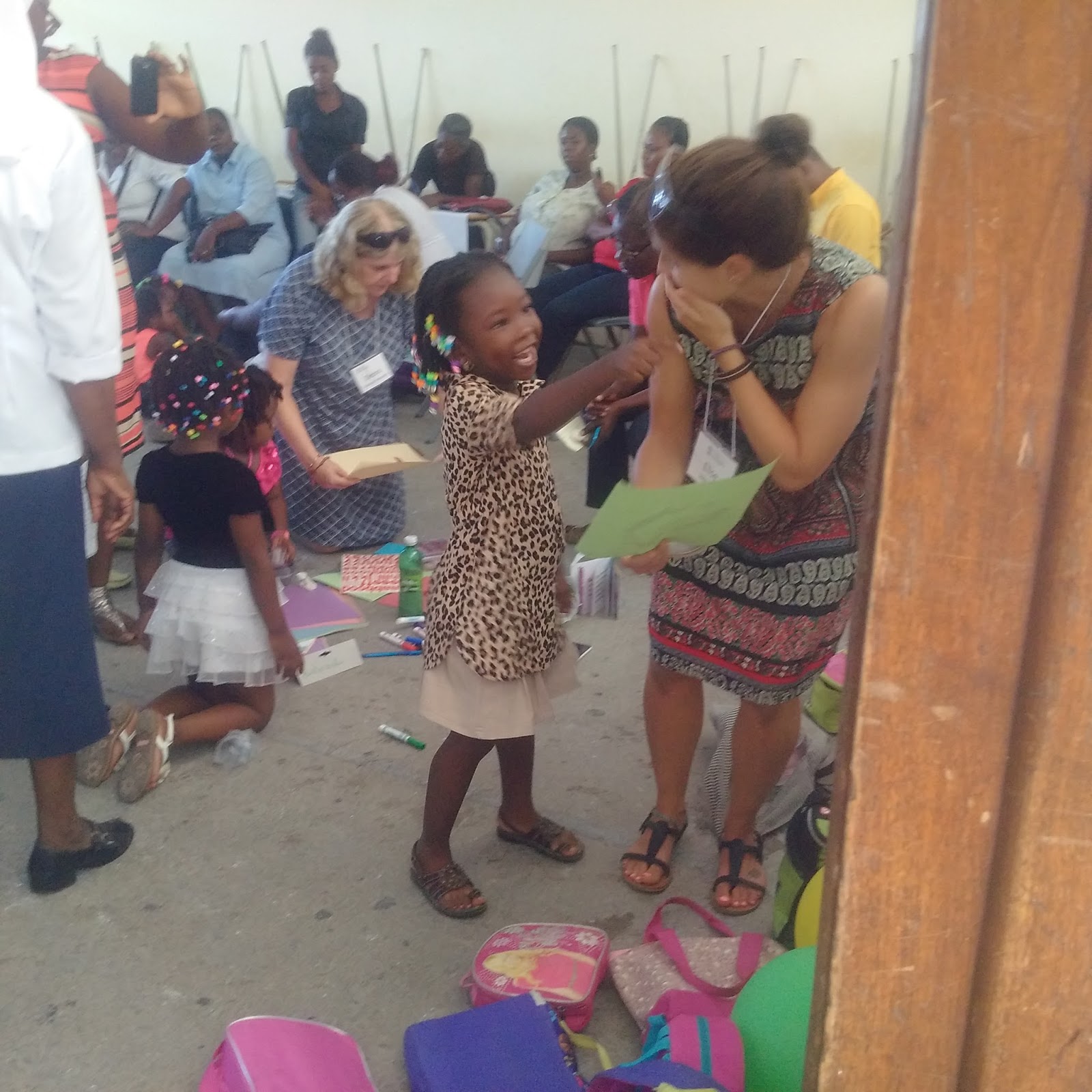 |
| One of our Canadian instructors with a Haitian student during the afternoon practicum we offered |
 |
| Special education course |
 |
| Haitian participants leading a math workshop for their peers |
 |
| What do Haitian teachers (and a Canadian young person) do during lunch break?! |
 |
| English and robotics camp |
 |
| English and robotics camp |
 |
| English and robotics camp |
 |
| Lunches provided to all participants thanks to generous sponsors |
 |
| Laurier and Desire2Learn well represented in the summer institute |
 |
| Samy, to my right, coordinated the university English language program, and his sister, Sasha |
 |
| English language program with university students |
Friday, August 5, 2016
Haiti Educator and Leadership Institute: Why do we do this?
This graphic expresses in such simple ways why we engage in supporting teacher professional development in Haiti: Teachers who are highly engaged in their work will support higher student outcomes. The snowball effect is: higher wages, economic growth, gender equality, improved health, peaceful society, and innovation.
This past week, we have supported the professional growth of 200 teachers. At today's concluding sessions we heard illustration after illustration of how the training is motivating teachers in Haiti to engage in more active and involved teaching. These teachers are committed to two more years of participating in the Educator and Leadership Institute. Their students will be direct beneficiaries of the professional growth!

This past week, we have supported the professional growth of 200 teachers. At today's concluding sessions we heard illustration after illustration of how the training is motivating teachers in Haiti to engage in more active and involved teaching. These teachers are committed to two more years of participating in the Educator and Leadership Institute. Their students will be direct beneficiaries of the professional growth!

Haiti Educator and Leadership Institute: Online Teacher Professional Development in Fragile Contexts
Teachers regularly engage in professional development, sometimes in face-to-face settings (e.g. workshops, conferences) or online (additional qualification courses).
However, the opportunity for online professional development for teachers in countries such as Haiti is extremely difficult to facilitate. This is largely due to the limited knowledge and experience that teachers have with online learning. A second major issue is the limited structure to support online learning in places such as Haiti (e.g. teachers might not have computers or may have a difficult time paying for Internet access).
Although the second issue is largely beyond our control, we are finding that teachers are increasingly accessing the Internet and are purchasing (usually used) laptops, tablet computers, or phones.
We are addressing the first issue (limited exposure to online learning) through the Educator and Leadership Institute which we are involved with this week in Cap-Haitien, Haiti. Through the support of Desire2Learn, we have been able to develop three basic online professional development courses: General Teaching, Mathematics, and Science.
 Yesterday, we inquired of our 200 participants who might be interested in participating in this pilot project AND who had regular access to a computer and the Internet. Nearly 80 people responded! Today, we provided a very basic introduction to online learning. We have already had 10 log in and begin exploring resources and posting comments!
Over the next few weeks, we will be releasing new aspects of the courses so that the participants can access resources and engage in discussions online. A research study is accompanying this project to study the challenges and barriers that participants experience as well as how the online experience may contribute to their confidence (efficacy) as teachers.
The examination of online teacher professional development in fragile contexts has had limited study. Our work in Haiti will certainly contribute to this knowledge that so that student learning and outcomes can be improved, not just in the developed countries of the world, but in all contexts.
However, the opportunity for online professional development for teachers in countries such as Haiti is extremely difficult to facilitate. This is largely due to the limited knowledge and experience that teachers have with online learning. A second major issue is the limited structure to support online learning in places such as Haiti (e.g. teachers might not have computers or may have a difficult time paying for Internet access).
Although the second issue is largely beyond our control, we are finding that teachers are increasingly accessing the Internet and are purchasing (usually used) laptops, tablet computers, or phones.
We are addressing the first issue (limited exposure to online learning) through the Educator and Leadership Institute which we are involved with this week in Cap-Haitien, Haiti. Through the support of Desire2Learn, we have been able to develop three basic online professional development courses: General Teaching, Mathematics, and Science.
Over the next few weeks, we will be releasing new aspects of the courses so that the participants can access resources and engage in discussions online. A research study is accompanying this project to study the challenges and barriers that participants experience as well as how the online experience may contribute to their confidence (efficacy) as teachers.
The examination of online teacher professional development in fragile contexts has had limited study. Our work in Haiti will certainly contribute to this knowledge that so that student learning and outcomes can be improved, not just in the developed countries of the world, but in all contexts.
Wednesday, August 3, 2016
Laurier Educator and Leadership Institute: College Notre Dame and College Regina Assumpta
The locations for Laurier's summer institute are College Regina Assumpta and College Notre Dame. They are both excellent Catholic schools with beautiful locations and campuses in Cap-Haitien.They are by no means "normal" as per typical Haitian schools but provide an excellent place to host an institute as large as ours.
More important than the physical location is the commitment of the leaders from both schools to build the capacity of children and young people in their school communities. They are highly committed and passionate leaders!
More important than the physical location is the commitment of the leaders from both schools to build the capacity of children and young people in their school communities. They are highly committed and passionate leaders!
 |
| College Regina Assumpta |
 |
| College Regina Assumpta |
 |
| College Notre Dame |
 |
| View from College Notre Dame |
Tuesday, August 2, 2016
Haiti Educator and Leadership Institute: First Report
A team of 30 Canadian and 12 US educators are part of our summer Educator and Leadership Institute in Cap-Haitien, Haiti.
We have had an amazing start to the institute! Here is an overview of the first two days:
1. Teacher Training: 220 Haitian teachers are registered for the institute! There are six courses including: Math, Science, Critical Literacy, Early Learning, Special Education, and School Leadership. Each course is being led by two Canadian educators, each of whom speaks French. There have been rave reviews from the Haitian participants!
2. English and Science Camp: 110 children, ages 4-14 are in the morning camp being led by a group of Haitian high school students, Laurier Bachelor of Education students, and education students from Central Washington University and Northeastern State University. Everyone is having an amazing time including the group of 18, 4 and 5 year old girls!
3. University English Program: 25 university students are in the afternoon camp being led by a former Haitian student from our English program as well as the Laurier B.Ed. students. Many students are saying this program has been the highlight of their day.
4. Research Project: We are researching the teaching efficacy of (belief that you can make a difference in students) and process of online learning for Haitian teachers. Both studies are significant in their scope.
My internet connection is limited but it's important to report that things have started amazingly well! Stay tuned for pictures when I have a better internet connection!
We have had an amazing start to the institute! Here is an overview of the first two days:
1. Teacher Training: 220 Haitian teachers are registered for the institute! There are six courses including: Math, Science, Critical Literacy, Early Learning, Special Education, and School Leadership. Each course is being led by two Canadian educators, each of whom speaks French. There have been rave reviews from the Haitian participants!
2. English and Science Camp: 110 children, ages 4-14 are in the morning camp being led by a group of Haitian high school students, Laurier Bachelor of Education students, and education students from Central Washington University and Northeastern State University. Everyone is having an amazing time including the group of 18, 4 and 5 year old girls!
3. University English Program: 25 university students are in the afternoon camp being led by a former Haitian student from our English program as well as the Laurier B.Ed. students. Many students are saying this program has been the highlight of their day.
4. Research Project: We are researching the teaching efficacy of (belief that you can make a difference in students) and process of online learning for Haitian teachers. Both studies are significant in their scope.
My internet connection is limited but it's important to report that things have started amazingly well! Stay tuned for pictures when I have a better internet connection!
Subscribe to:
Posts (Atom)