Glocal Perspective Building
"Global" and "local" are constructs which no longer adequately capture our lived experience. "Glocal" attempts to capture the melding of international and local realities. This blog provides an opportunity to consider how we can develop glocal thinking and encourage others to do so as well.
About Me
- Steve Sider
- I have been an elementary and secondary school teacher and administrator. Currently, I am a faculty member in the Faculty of Education at Wilfrid Laurier University, Waterloo, Ontario, Canada. My M.Ed. and Ph.D. had a focus on the educational and linguistic experiences of children who moved from other countries to Canada.
Tuesday, August 25, 2026
Internationalization: Vision, approach, and experience
Tuesday, March 4, 2025
Inaugural eastern Caribbean regional inclusive education conference: Building research and professional networks to support inclusive education for students with disabilities in the eastern Caribbean.
The inaugural eastern Caribbean regional conference on inclusive education occurred from February 26-28, 2025 in Rodney Bay, St Lucia. The title of the conference was: Building research and professional networks to support inclusive education for students with disabilities in the eastern Caribbean.
The overarching question guiding the conference was: How can researchers and educational system leaders collectively work to foster inclusive education for students with disabilities and special educational needs in the eastern Caribbean?
The conference had four specific objectives:
Objective #1: Provide an inter-sectoral knowledge exchange on inclusive education through presentations, discussions, resource-sharing, and resource development.
Objective #2: Facilitate the development of connections to support future collaborations in research and practice focused on inclusive education.
Objective #3: Support the creation of a working group that will engage in future research priorities, formal research partnerships, and collaborative networks in inclusive education.
Objective # 4: Mobilize knowledge beyond the conference through the development of research-informed resource materials on inclusive education for various stakeholder audiences.
How did the conference come to be? As a result of a conversation over dinner two years ago. I had come to St Lucia to participate in another conference and was introduced to Mr. Dale St Juste, education officer with leadership responsibility for special education in the St Lucia Ministry of Education, Sustainable Development, Innovation, Science, Technology and Vocational Training. As we had dinner, I was struck by his comment that he did not know people with similar responsibility in the surrounding islands. As we talked about the challenges of supporting students with disabilities and special educational needs in St Lucia, we decided to put effort into bringing the leaders from the surrounding islands together to network, share resources, and simply get to know each other (see Objectives 1-4 above). We successfully applied for and received a Social Sciences and Humanities Research Council (SSHRC) of Canada Connection Grant (it was the #1 ranked application, just saying!) and started planning for the conference.
![]() |
| Mr. Dale St Juste welcoming participants to the conference |
In addition to Mr. Juste, other representatives from the Ministry of Education participated in the conference. Miss Angel Caglin of the Caribbean Innovation and Leadership Lab, gave leadership to facilitating discussions at the conference.
![]() |
| Miss Angel Caglin presenting |
The Honourable Shawn Edward, Minister of Education for St Lucia, started the conference with a call to include and further improve education for disabled students and those with special educational needs. The conference was honoured to have other high level officials in attendance including the Chief Education Officer, Mrs. Beverly Dieudonne, and the deputy CEO, Mr. Cyrus Cepal. Dr. Kathy Hogarth, associate vice-president of global strategy at Wilfrid Laurier University in Canada, was also in attendance and provided greetings.
![]() |
| Dr. Kathy Hogarth, associate vice-president of global strategy at Laurier; Honourable Shawn Edward, Minister of Education for St Lucia; Mrs. Beverly Dieudonne, Chief Education Officer for St Lucia |
In addition to St Lucia, representatives from the countries of Anguilla, Antigua & Barbuda, Dominica, Barbados, British Virgin Islands, Grenada, St. Kitts and Nevis, Montserrat, and St Vincent and the Grenadines were present.
We were delighted by the active participation in the conference of Mrs. Sisera Simon and Mr. Rafer Gordon, the top education officials from the Organization of Eastern Caribbean States (OECS). The OECS is the "connected tissue" that supports regional integration in the eastern Caribbean.
![]() |
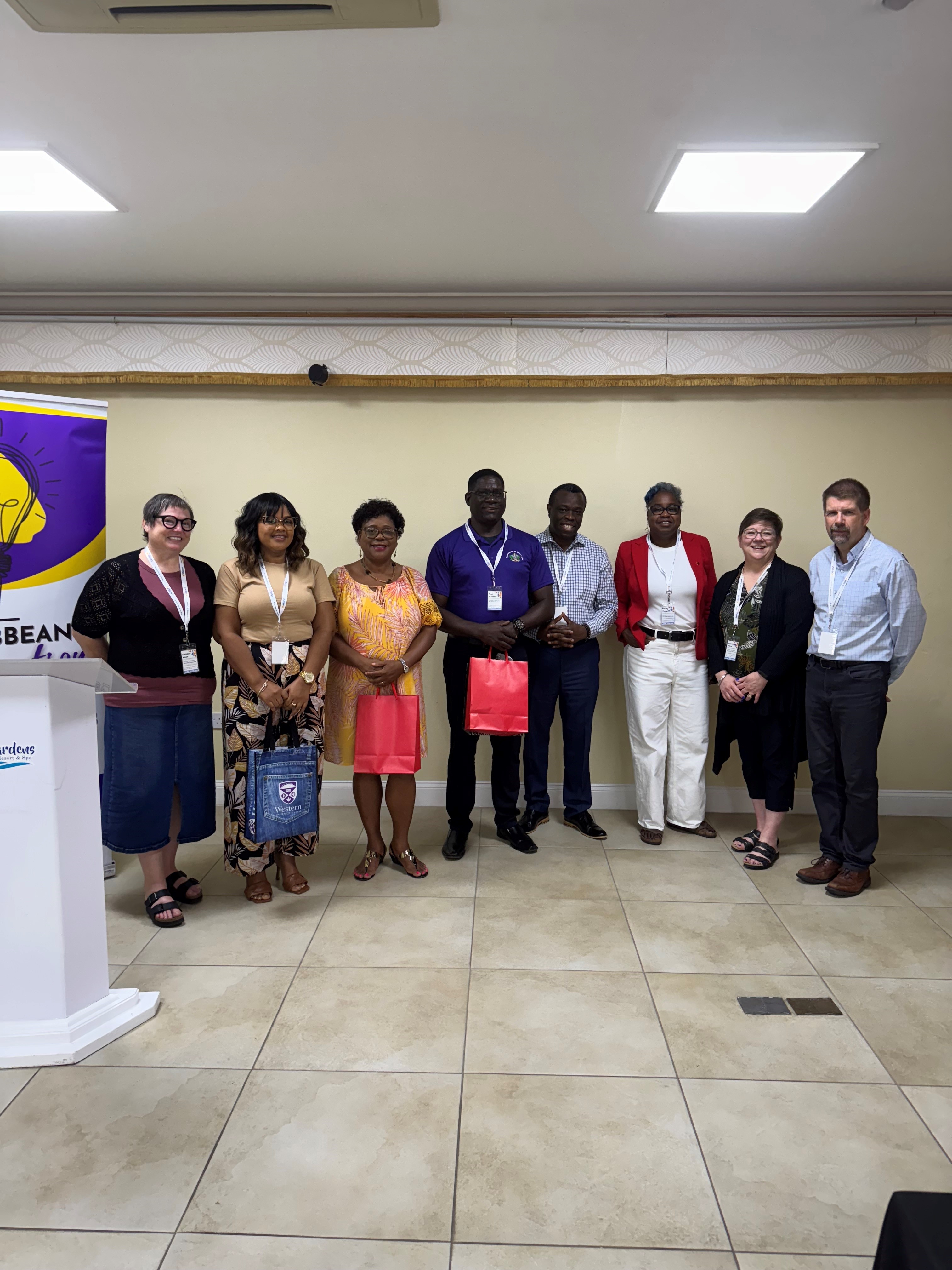
| Conference Organizing Team |
The organization of the conference was supported by Canadian participants including Dr. Jacqueline Specht, Dr. Kimberly Maich, Dr. Jhonel Morvan, and myself. Dr. Specht and I provided keynote addresses which focused on an overview of research on inclusive education globally and case examples of inclusive education policy to practice in small island states.
![]() |
| Dr. Sider speaking |
At the conclusion of the conference, participants indicated that the objectives had been met, that they had established new professional relationships, and nurtured their own leadership competencies to support inclusive education for students with disabilities and special educational needs. The group looks forward to further collaborative opportunities to build capacity for inclusive education in the eastern Caribbean. The group has already begun actively sharing resources and developing a community of practice.
A conference of this magnitude could not occur without significant support from multiple sponsors and funders. These included:
Saint Lucia Ministry of Education, Sustainable Development, Innovation, Science, Technology and Vocational Training
Social Sciences and Humanities Research Council (SSHRC) of Canada
Wilfrid Laurier University Faculty of Education
Wilfrid Laurier University Office of Research Services
Office of Global Strategy at Wilfrid Laurier University
Canadian Research Centre on Inclusive Education
Caribbean Innovation & Leadership Lab
Wednesday, November 6, 2024
Who is my neighbour?
I haven't written in this blog for a year but last night's US election results, and the sleepless night that followed, have drawn me to writing as a form of therapy (or resistance).
I've tried to seek to understand the results, and probably more accurately, the motivation of people to vote as they did. I am at a loss in this effort to understand. I guess what I do know is that I don't know nor do I understand. Maybe that's a start.
But what has really given me some angst is trying to sort out my own thinking in how I respond on a person-by-person, individual level to people with whom I disagree (and, of whom I don't understand).
In the Christian faith, a person asks Jesus who is their neighbour (Luke 10). Jesus responds by telling a story. In that story, he flips the narrative so that the neighbour is someone who we might never imagine. It's someone that we might not get along with, someone we don't understand. It's also someone who is in need. And for/with/to whom I am confronted with whether I take action to help.
Some people refer to this as the Golden Rule: treat others as you would want to be treated. More recently, I have heard people reference the Platinum Rule which emphasizes seeking to understand other peoples' preferences, what they want and not what I might want, and taking action accordingly.
In a way, the idea of being a neighour is very much aligned with the idea of "glocal." Being a neighbour isn't just about the person who physically lives near to me. It's recognizing that being a neighbour is about recognizing need, seeking to understand how to respond to that need, and taking appropriate action. No matter who it involves. Or where.
This morning, I've been thinking of my neighbours who are fighting a war in Ukraine, who are undocumented workers in the US, and who are girls and women who think the presidential glass ceiling will never be smashed. My heart aches for them in the wake of the results of the election. But what has really bothered me is recognizing that my neighbours are also the people who voted for a person whom I have no respect for, someone who I find intolerable. Some of these neighbours are quiet, well educated, and probably lovely people who would help me in a heartbeat. Others of whom are racist, misogynistic, and homophobic. And I recognize that most of us are all of the above. They/we are all neighbours, for better or worse.
This morning, I don't know what action to take. I've sent some notes to people I care about. I've taken the dog for a walk. That's about it. Before I act, I need to continue to seek to understand. I have a feeling it's going to be a long process.
Friday, May 12, 2023
Hamdella: Egypt, partnerships, and comparative education
According to my passport, the last time I was in Egypt was August 2019. I was three days from coming to Egypt in March 2020 when COVID-19 hit and all my plans were changed. Today, I arrived back in Cairo for the first time in nearly four years. I have heard "hamdella" [welcome] from those I know. It's a wonderful word.
I am here for two primary reasons:
1. Discussions with colleagues at the American University of Cairo, considered the best university in the region, regarding potential partnerships and research collaborations. I am meeting with multiple faculty members who have common research interests. I also have meetings with the director of the Education program who I have only met via video conferencing in the past. I am fortunate to have a colleague at Laurier who has a long history with ACU and who has nurtured these connections.
2. Ongoing work with Dover International School, a school that I have worked with for close to 10 years. The director is a former director of a school board in Ontario who I worked with in that context. He retired and took on the role of director of this international school. This May, we have 19 Laurier teacher candidates at Dover. Over the next few days, I'll be working with some of the teachers at Dover who I have had research projects with and also supporting our Laurier teacher candidates as they learn about teaching in a different context than Ontario.
There's always much to learn when you travel. For example, did you know that weekends in Egypt are on Friday/Saturday? The holy day is Friday. My learning will continue on this trip as I find out more about how educators in Egypt engage with topics such as school leadership, innovation, and inclusive education for students with disabilities.
Sunday, March 12, 2023
Innovation and inclusion in education: Three aspects from St. Lucia
I have spent the past week and a half in St. Lucia, 1/3 of that time spent in a conference on innovation in education, 1/3 spent in research team meetings, and another 1/3 spent exploring special education on the island.
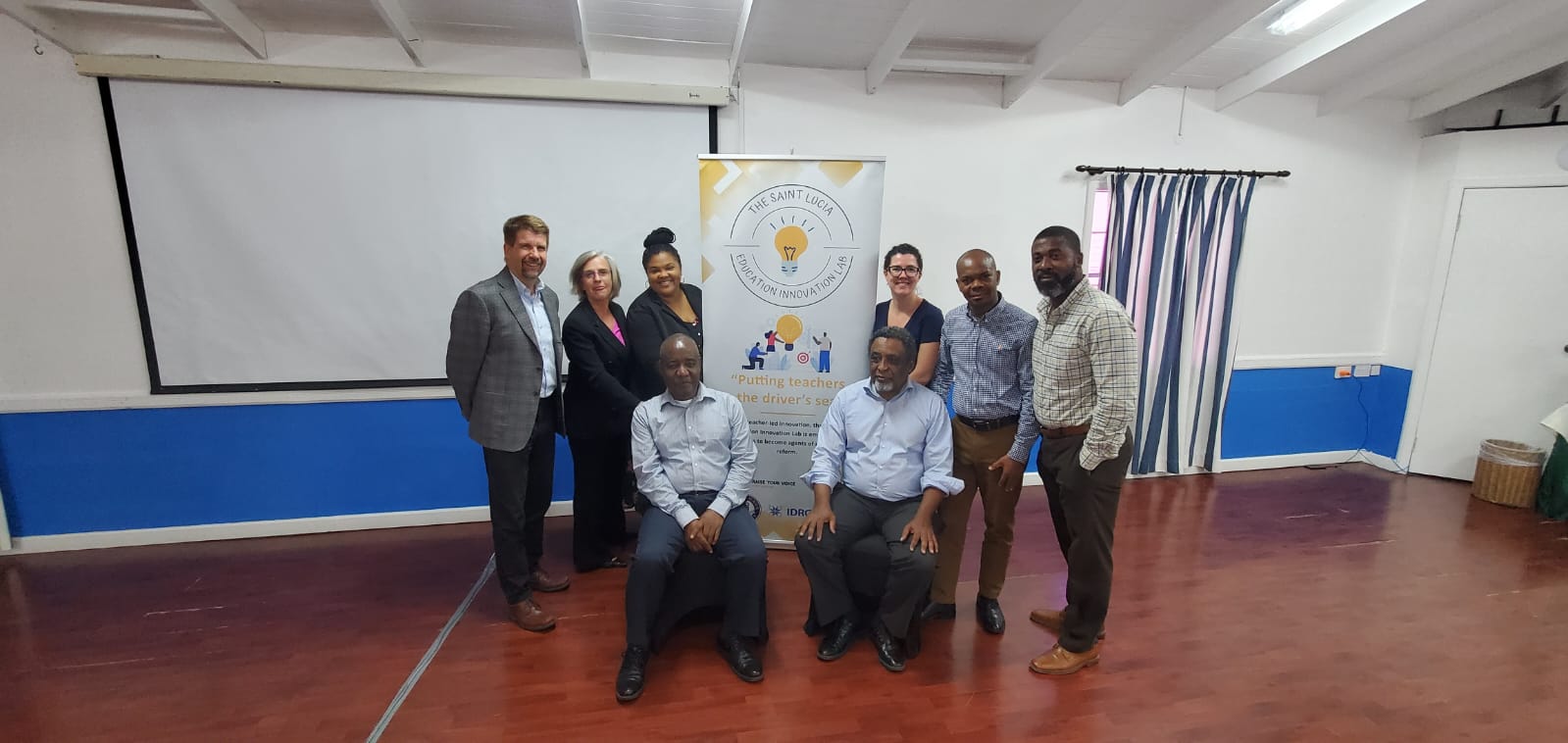
First, the conference was the first Caribbean Education Innovation Forum. It was supported by a Social Sciences and Humanities Research Council of Canada (SSHRC) Connection Grant. The purpose of the forum was to bring a variety of educational stakeholders from the Eastern Caribbean together to discuss innovation in education. There were seven countries involved (as well as four of us from Canada) and each country had a Ministry representative (i.e., a system leader), a principal, and a teacher. The two-day conference included a couple of keynote presentations and many break-out sessions. The value of the break-out sessions were in the variety of approaches: some were role-specific (e.g., all principals met), others were topic-specific (e.g., inclusive education), and others were country-specific (e.g., the three reps from a particular country met to debrief a topic). There were many, many rich conversations. There seemed to be good support for a follow-up step to include applying for a grant that would provide further opportunities for program-development and research on innovation in education.
Second, the research meetings included our International Development Research Council (IDRC) team which is exploring teacher innovation in St. Lucia and Haiti. The team met for two days to debrief the work that has been done over the past 1.5 years in these two contexts and to plan next steps. One action step that I will be contributing will be editing a special issue of a comparative and international education journal to focus on some of the research related to this project. There has been some good progress in St. Lucia and Haiti with teacher innovation projects. We are hoping to be able to leverage the forum we hosted at the beginning of the week and the work we have been doing in St. Lucia and Haiti to scale the Human Centered Design innovation projects in other contexts.
It has been a very productive week with excellent discussions, mobilization of information about current effective practices, and brainstorming on possibilities for the future.
Friday, February 24, 2023
Experiences with inclusion and stigmatization in Kumasi, Ghana: We fear what we don't know
We have spent this week in meetings with students with disabilities, as well as their parents, teachers, and school administrators, in Kumasi, Ghana. The research project is funded by the Social Sciences and Humanities Research Council of Canada (SSHRC) and is part of a four year project to explore inclusive education for students with disabilities in Ghana. An anticipated outcome of the project is the development of training resources to help teachers foster inclusive classrooms. Our last research trip to Ghana was in December 2019, just a few months before the Covid-19 pandemic (see previous post).
The activities of this week have led to new insights about inclusive education not only in Ghana but also in Canada. Here are some quotes which really resonated with me:"It [disability] feels like a punishment."
"We [teachers] are professional beggars [since they have to beg for supplies and resources]."
"When a parent gives birth to a disabled child, you have to really try or your child will die."
"Teachers with disabilities feel rejected."
"I have not had a salary for two years."
"We're draining the family finances."
"If not limited by space, the numbers of students with disabilities we would have would be huge."
"We fear what we don't know."
Research can seem like a "cold" and sanitized process. However, qualitative research that centres the stories and experiences of participants makes the research come alive. Real people are telling compelling stories of challenging, mundane, joyful, everyday, and traumatic experiences.
One 18 year old was burned in an accident at a young age. She was left with significant physical limitations. Yet, she is completing secondary school and is looking for ways to ensure a brighter future.
A child in primary school is able to attend classes because her parents and teachers have committed to ensuring that she can attend school despite her physical restrictions.
A university student told us about how access to a powered wheelchair has allowed him to move across the university campus.
Yet, these are not stories of inspiration. There are daily struggles. Not everyone gets the chance to remain in school. Yesterday, a principal told us of a single-parent who has had to remove her child with a disability from the school because she cannot pay the fees. A common theme across the stories we have heard is of stigma and discrimination that children and young people with disabilities have encountered (and continue to encounter).
There is no doubt that we have made massive progress in supporting students with disabilities in schools. Not that long ago, students with disabilities in Canada and in Ghana were ostracized from schools or placed in segregated settings. This still happens in many parts of Ghana. In Canada, children still experience segregation from other children. But progress is being made. We must continue to fight for the right of every child to belong in their community school.
Sunday, February 19, 2023
Returning to international research after Covid-19
I have been "missing in action" as far as writing in this blog for the past two years. I blame Covid-19 but it might also be a reflection of the sense of "pause" that much of my life has been under during this time.
My international research projects took many different directions during Covid-19. One large project in Haiti, funded by the Canadian government (SSHRC), has been on hold since I am not able to currently travel to Haiti and that project requires more interaction on-the-ground with partners. Another one that involves Haitian partners continued but we were able to engage in research meetings in other countries. Work in other contexts such as Ghana, Egypt, Kenya, and Ethiopia were all on hold. Two other projects involving more remote-based work, one in Mauritius and the other in sub-Saharan Africa, were able to be successfully completed by mid-2022.
This fall, opportunities for travel started ramping up in earnest. I traveled to Mauritius to work with the Special Education Needs Authority (Ministry of Education) in launching their new effort to support all children, regardless of need or strength, in their neighourhood schools. Being on-the-ground in Mauritius reminded me of the incredible privilege involved in international research partnerships.
I am now in Ghana, about to board a flight to Kumasi, where we will be working on an inclusive education project. In fact, the last international trip I took prior to the Covid-19 pandemic was to Ghana where we worked in Accra and Tamale. Being back in Ghana is wonderful but bitter-sweeet. Since we were last here in December 2019, our key research partner in Tamale, Sayibu Imoro, has passed away. He was a huge champion for inclusive education.
After returning to Canada at the end of February, I will be traveling to St. Lucia to meet with the partners on an IDRC-funded project. We have just submitted a proposal to SSHRC to extend/scale the project on teacher innovation that we have been working on in St. Lucia and Haiti. If funded, it would enable us to support innovation projects in education in other contexts in the Caribbean.
Covid-19 has certainly caused many pauses in international research projects and, unfortunately, many more negative and sobering consequences. However, a pause, just like a time-out in basketball, can be a time to reflect, re-group, and re-strategize on key steps forward. I'm very thankful for the privilege to be engaged in re-imagining international research partnerships and projects going forward.