About Me

My photo
I have been an elementary and secondary school teacher and administrator. Currently, I am a faculty member in the Faculty of Education at Wilfrid Laurier University, Waterloo, Ontario, Canada. My M.Ed. and Ph.D. had a focus on the educational and linguistic experiences of children who moved from other countries to Canada.

Monday, March 25, 2019

Educator and Leadership Institutes 2019: Egypt, Nepal, Haiti ... and beyond

It’s exciting to see the Educator and Leadership Institute (ELI) evolving in the three contexts where we have launched: Haiti, Egypt, and Nepal.
ELI sites in Egypt and Nepal are in full swing at this time of the year. A team of six Canadian educators spent last week in Egypt working with 200 teachers. A team of 20 Canadians will be in Nepal in mid-April for a similar training session with about 300 Nepali educators.


At this point, we are continuing with our plans for ELI Haiti to proceed as per normal. If you have not followed the news of Haiti over the past year, you are not likely aware of the protests and other challenges that have confronted the country. You can find a good overview here. The northern city of Cap-Haitien, where ELI is situated, has not had nearly the same problems as Port au Prince. However, the foundational issues are the same throughout the country (injustice, corruption) and so Cap-Haitien is not immune to some of the same troubles. Our Haitian partners are clear in their commitment to ELI: Building the capacity of teachers (and thus students) is key to this country’s future.

I anticipate being in Haiti in a few weeks as we spend a weekend in intensive training with 25 Haitian instructors who will start taking on more teaching responsibility this summer. This is part of our sustainability plan for Haiti. We anticipate another 600 Haitian participants in ELI from Aug. 5-9 with a team of 40 Canadians providing leadership. Our Haitian instructors will be “co-teaching” with the Canadian instructors this summer.

Last week, I met with organizations working with educators in Ethiopia and Kenya as we look to launch sites in these contexts in 2020. There is a deep hunger for professional learning for teachers in these contexts. Why? Because education is key to other outcomes:


Teachers are looking for professional training and the ELI model is helping to bridge the divide between teachers globally so that they can learn from each other's experiences. It is a powerful model that is making a real difference in the lives of teachers AND students globally.

Wednesday, March 20, 2019

The tricky business of expectations: ESL students and their career aspirations

I've been asked to help English as a Second Language (ESL) students at a local high school develop realistic and alternative expectations for post-secondary options. The issue stems from the fact that many of the students think that they are going to be surgeons or lawyers but are struggling to pass basic math courses. This is not as "simple" as just building their linguistic ability so that they can do the math work (or other subjects) but a more complex issue of realizing that they might not have the aptitude for such careers.

This is not really that different than the experience of non-ESL students: We all dream of different careers when we are young and these get tempered as we get older. Some of this is because we start determining what we would enjoy and be successful at. But it's also because we start to develop a more realistic sense of our own abilities.

The difference for some ESL students is that career aspirations may be a "shared" expectation. By this I mean that the career aspirations may be "assigned" to them by their parents, either overtly ("you are going to be a pharmacist") or covertly through interactions and innuendos. Parents of ESL students have often had to overcome incredible obstacles to live in Canada. They may feel that their sacrifices should lead their children, with enough work and focus, to embark on the most respectable and highest-paying professions possible.

Expectations are tricky ... we promote a "can do" attitude in schools (e.g., growth mindset) but we are also accountable to ensure that we are not supporting unrealistic expectations. Part of our job is to work diligently to ensure that students are learning beyond what they could do by themselves but at the same time helping students recognize that they may not have the skill set or cognitive ability for certain careers.

This reminds me of Lev Vygotsky's Zone of Proximal Development (ZPD):
Zone of Proximal Development
http://www.innovativelearning.com/educational_psychology/development/zone-of-proximal-development.html
Teachers work in the ZPD (that would be a great name for a book or movie!). We help students do more than what they could do (or be) by themselves. But there are limits to the ZPD and we need to help students (and parents/guardians) carefully manage unrealistic expectations so that students are challenged to go beyond what they think is possible while not living with unrealistic and unattainable expectations.

It's a funny business ... we want students to reach for the stars but we also want to temper that with the reality that most of us are going to work on this planet!

Thursday, March 7, 2019

The head, heart, and hands of school leadership: Lessons in leadership from ESL teachers

Recently, I've been supporting teachers at a local high school in developing strategies for the inclusion of English as a Second Language (ESL) students in the school context. This week, I sat in on a department meeting of five ESL teachers in the school. It was a powerful reminder that we have amazing teachers supporting some of the most vulnerable and marginalized students.

The teachers represented the head, heart, and hands of leadership.
The Head, Heart and Heart work together.
Source: https://www.livingcities.org/blog/727-head-heart-hands-a-framework-for-taking-action-on-racial-equity
Head: The teachers had excellent knowledge of their students. There are well over 100 ESL students in this school of 1,400. The teachers discussed them by name, pointing to specific areas of strength and need. They talked about how the students were performing in class. They discussed resources that could support learning. The teachers clearly knew the students and they knew their subject area.

Heart: I was struck by the extent of the conversations that revolved around the affective domain of learning (emotions, feelings, attitudes). The teachers talked about field trips to local theatre productions and to a local college to find out about alternative post-secondary pathways beyond university. They planned a fun night for the ESL students. They clearly cared for their students.

Hands: The teachers planned multiple support sessions for the students who are preparing for a major provincial literacy test. They did not just teach the student in a course but recognized the importance of more individualized support that would happen in tutoring sessions. They jumped in to help each other with planning events. They clearly were not afraid to get their hands dirty!

To me, these traits are not "just" about teaching; they are about leadership. The teachers are modelling the kinds of behaviours and characteristics that we want for these young Canadian and global citizens: to be engaged, to care, to work hard, to make a difference.

Real teachers making a real difference through their heads, hearts, and hands.

Wednesday, March 6, 2019

Evidence-based decisions in a post-truth era: Sign-posts that point us in the right direction

I think we need to have a Wikipedia-like website where people can easily find evidence-based, research-informed articles on the "hot topics" in education today.

Part of the challenge in a "post-truth" era is finding "good" evidence. To me, good evidence is that which is thorough and consistent. In the research world we would call this reliable and valid.

It's important to acknowledge that it's difficult to "prove" an educational issue. Indeed, science that involves humans is rarely perfect. As well, sometimes we have a tendency to "cherry pick" evidence that meets our needs. Click here to read a good article on this.

However, if we think of evidence as a sign-post it may help. Sign-posts point us in the right direction. The more sign-posts we see, the more confidence we have that we are moving in the right direction and that we are getting closer to the right destination.
Image result for signposts and research
Signposts at Bellingshausen Station Research Base King George Island
Source: https://havecamerawilltravel.photoshelter.com/image/I0000XZZrYPSJsUU
So in an effort to provide sign-posts in the right direction here's a start. Is the evidence perfect? No. But I see this as an opportunity to engage in pointing in a valid and reliable direction. In other words, getting us to the point where we can make informed, helpful decisions based on evidence and not rhetoric.
  • Want evidence about the effectiveness of early learning (e.g, full day kindergarten)? Click here.
  • Want evidence about the importance of healthy human development education? Click here.
  • Want evidence about the value of teaching our children about Indigenous peoples and the legacy of residential schools? Click here.
  • Want evidence about the importance of system-wide and early interventions to support students with autism? Click here.
  • Want evidence about the importance of maintaining small class sizes? Click here.
My motivation for this has been my disappointment in the way that our Ontario government is making decisions that effect children. These decisions appear to be more partisan than evidence-based. Over the past ten years, Ontario has been noted as one of the top-performing educational systems in the world. Want evidence? Click here.

I have offered my support to my local Member of Provincial Parliament to happily provide him with research on the key educational issues of the day. I'll be curious if my offer is accepted.

Tuesday, February 19, 2019

Change in Haiti begins by casting light in the darkness

The news from Haiti over the past few days has been disheartening.

Protests, corruption, economic disparity, inflation, schools closed, hospitals without supplies ... and the list goes on.

Beyond the new headlines that have caught our attention are the countless stories that are not deemed newsworthy: People who just want tomorrow to be better than today. People who  want their children's lives to be better than their own. People who want safe and secure housing. People who want a fair opportunity to make a basic income.

I'm hearing these stories through the discussions I'm having online with friends and colleagues in Haiti. People are frustrated. They want things to be different ... to be better.

I continue to be convinced that "different" and "better" will only happen through a concerted effort to improve the education system of Haiti. Children who are literate have greater potential for higher income levels. Young people who develop critical thinking skills will be less prone to corruption. Young adults who are educated will develop the skills and knowledge needed to work for change.

We are supporting education capacity in Haiti for the long-term. The current situation sheds light into some of the darkness that Haitians have to deal with. But if we don't see - and deal with - the "junk" then it will continue to fester. Education provides people with the tools to both see and to take action on these foundational issues of development.

Paolo Freire described a process of "conscientização" (Portuguese for conscientization) ... an awakening or consciousness raising. Haitians are increasingly conscious of the systemic issues at play. Will they resort to the "same old" or will a new era arise?


Tuesday, November 13, 2018

Why do you lead the way you do? A theory of action in 100 words or less

Leadership fascinates me.

I suspect that part of this fascination is that I've experienced really good examples of leaders and a few that were not so good. I'm guessing that anyone reading this blog can relate to that!

What separates the really good leaders from the really bad leaders? Or, for that matter, what separates the really good leaders from those who are mediocre?

We talk a lot about the traits and skills that leaders have but I'm convinced that some of the examples of bad leaders I've seen share similar traits to those who have been really good leaders. For example, one leader who I really respect is very conscientious in seeking input into decisions. I've seen this same trait in another leader who genuinely sought input into decisions but who was not highly respected despite doing this.

What's the difference?

I suspect there are many reasons but one that has recently caught my attention has been the idea of how (or why) we lead change.

One's "theory of action" is the how and the why of their leadership. It is the deep values we hold when we engage in leading change.

Harvard University's Project Zero provides a nice tool to consider to help unpack one's theory of action. Click here to find out more. A short 3 minute video on theory of action, featuring Dr. Steven Katz, is available by clicking here.

There are three key aspects of my theory of action:

  1. There is a a deep belief in the importance of reciprocity. Any change that I want to lead must consider the ways in which the change will impact others.
  2. I value the wisdom of elders. Others have insights for me that will most likely lead to effective change and minimize the risk of failure ... if I'm ready to listen.
  3. Change leadership requires me to remain humble. Is this change about me or is this about my students, my organization, or other stakeholders?

It is from these foundational beliefs and values that I lead change.

Could you describe your theory of action in 100 words or less?

Thursday, November 8, 2018

Without education there will be no change

I've recently been working on materials as part of applications that we are making to foundations and government agencies to help fund the Educator and Leadership Institute in Haiti.

As part of these materials, we developed a new video that features two female teachers, one Canadian and one Haitian, as they reflect on the importance of education.

To watch the video, click here.

One comment struck me in the video: "Without education, there will be no change."

In many ways, education and health care are the foundation of economic development, government stability, social cohesion, and gender equity. I have little control over a country's health care system but I can have significant influence over the educational quality of a classroom, a school, or even a system of schools.

This is exactly what we are trying to influence in northern Haiti: better teachers = better schools = better outcomes for students = better outcomes for a country

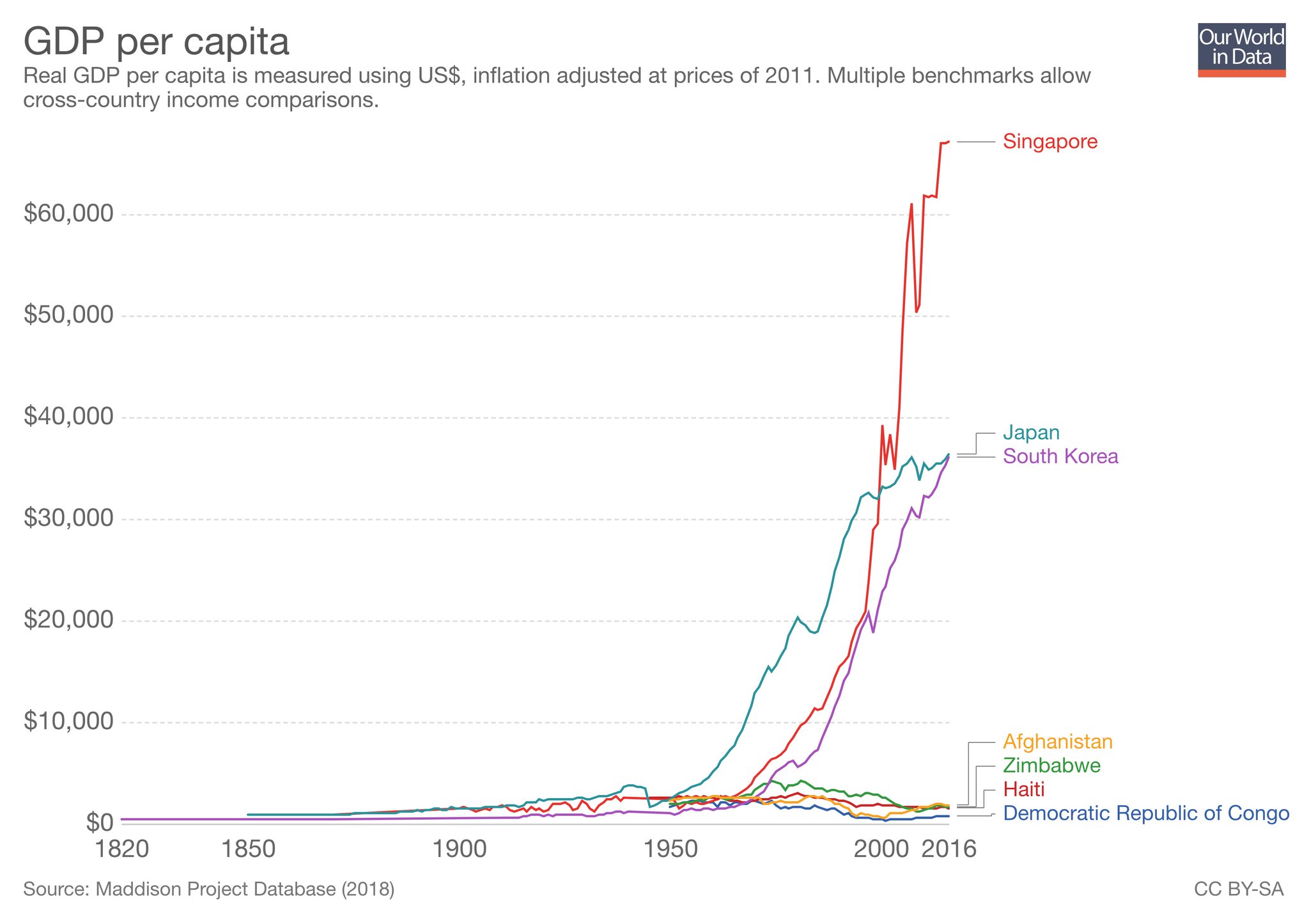
A researcher I follow, Max Roser, recently made this statement and provided evidence through the following graph:

"Until the 1950s people in Japan, Korea, and Singapore were as poor as people in Haiti, the Congo, Zimbabwe, and Afghanistan. Since then the first three economies achieved growth and the others did not."

When I look at the following graph, I think the fundamental reason that Japan, Korea, and Singapore have had such significant growth - while Haiti and others have not - is because of education.

Without education, there will be no change.